

Guide
Learning to cook Thai food in Pattaya
Where to actually learn Thai cooking in Pattaya, what a class involves, and why it's one of the better ways to spend a morning here.
7 min readPublished
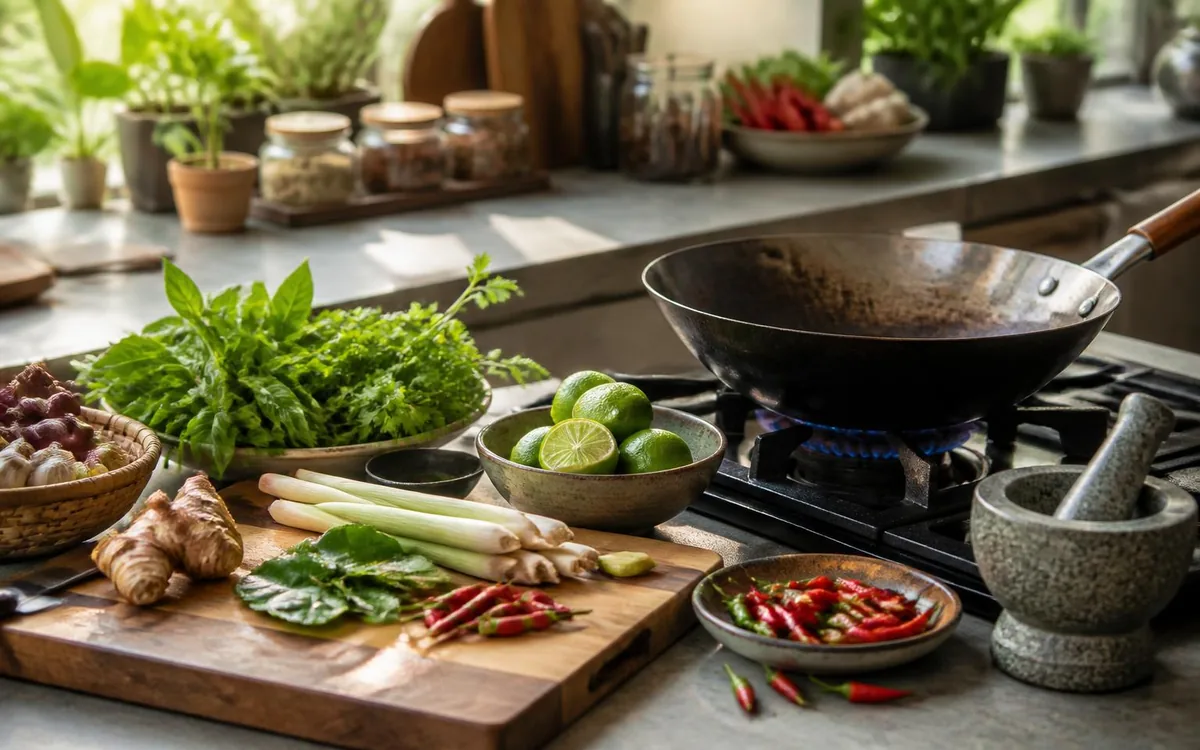
Illustration: The Pattaya Guide
A Thai cooking class is one of those experiences that sounds like a tourist activity and turns out to be genuinely useful. You leave with skills you did not have three hours earlier, and pad thai stops being a thing you order and becomes a thing you know how to make.
Pattaya has built a reasonable cooking-school scene over the past two decades, helped by the fact that it is not overwhelmed with day-tripping food tourists the way Chiang Mai and Bangkok are. Classes here run smaller, instructors have more time for each student, and prices are noticeably lower than the equivalent experience further north.
What an actual class looks like
Almost every school in Pattaya follows the same basic format. You arrive, get an apron and a recipe booklet, and cook three to five dishes over the course of a morning or afternoon session, each dish demonstrated first and then repeated at your own station. Most schools give each student their own wok and burner rather than working in shared groups, which matters more than it sounds like it should; it means you actually do the cooking rather than watching someone else do it.
The better schools start with a short walkthrough of the ingredients before anyone touches a wok: what galangal is and how it differs from ginger, how to tell lemongrass is fresh, which chillies to use for which level of heat. This is the part that actually changes how you shop and cook once you get home, more than the recipes themselves.
A typical class runs three to five hours, covers three to five dishes chosen from a set list, and finishes with you eating everything you made. Expect to choose from a list that usually includes some combination of pad thai, green or red curry, tom yum, tom kha gai, papaya salad, and a stir-fry, with schools offering twenty or so options across the menu so no two visits need to repeat.
Where to go
Happy Chef Cooking School, on Pattaya Klang, is one of the longer-established schools in the city, first opened in 2007, with a strong reputation among visitors for being welcoming to complete beginners and unconfusing about the English side of instruction, which is not always a given.
Happy Home Thai Cookery School, run by an instructor known locally as Sheri, is a smaller, more personal operation on Pattaya Klang Soi 12, built around the idea that cooking properly is part of running a good household. It has no connection to Happy Chef despite the similar name.
Pattaya Cookery School, in Soi Khao Noi in East Pattaya, has been operating for more than twenty years and covers a broader curriculum than most, including fruit and vegetable carving alongside the standard cooking classes, along with guidance on how to order properly at Thai restaurants once you understand what you are looking at on the menu.
Nah Pah Thai Cooking School, at the Royal Cliff Grand Hotel, is the hotel-resort version: a professional teaching kitchen with an adjoining herb garden where you pick some of your own ingredients, and a genuinely well-run children''s programme if you are travelling with a family. Expect resort pricing rather than street-level pricing.
Nongnooch Wonder World also runs cooking classes as part of its wider attraction, with a set curriculum covering the core five or six classic dishes, useful if you are already spending a day at Nongnooch and want to combine it with a hands-on session.
What it actually costs
Classes in Pattaya typically run well below equivalent experiences in Chiang Mai or Bangkok, generally in the range of a modest sit-down dinner for two once converted from baht. Hotel-based classes at properties like the Royal Cliff sit at the top end of that range; independent schools like Happy Chef, Happy Home, and Pattaya Cookery School sit lower. Most schools list current pricing directly on their own site or Facebook page, since these change more often than most other things in this guide, and it is worth checking directly before booking rather than relying on a number quoted somewhere else online.
Which one to pick
If you are a genuine beginner who has never cooked Thai food and wants a friendly, unrushed introduction, Happy Chef''s long track record and reputation for patience with first-timers makes it the safest default. If you want the more intimate, almost domestic version of the experience, Happy Home is the better fit. If you are staying on the East side of the city and want the most comprehensive curriculum, including techniques most tourist-facing classes skip, Pattaya Cookery School is worth the extra distance. And if you want the class folded into a resort day with a proper herb garden and don''t mind paying resort prices for it, Nah Pah at the Royal Cliff delivers a more polished, if less street-level, experience.
Beyond the class: cooking at home afterward
The class solves technique. Sourcing solves everything else. Once you know what you''re looking for, Pattaya''s wet markets, particularly Naklua Market and Thepprasit, are where you will find the fresh herbs, unusual chillies, and proper galangal that make the difference between a class dish and a supermarket approximation. For imported pantry staples like fish sauce brands, curry pastes, or specific noodle types you got used to in class, Foodland and Villa Market both carry a wider Asian grocery selection than the mass-market chains. See our Expat groceries guide for the full shopping map.
A note on expectations
Nobody leaves a three-hour class a professional Thai chef, and no school promises that. What you actually get is enough foundational technique, curry paste balance, wok heat management, when to add fish sauce versus when to add sugar, to cook a genuinely good version of five or six dishes at home, and enough understanding of the underlying logic to start adapting recipes yourself rather than following them exactly. That is a realistic and worthwhile outcome for a morning, and it is why cooking classes consistently rate as one of the better structured activities in a city that is not always associated with structured cultural experiences.
Common questions
- How long does a Thai cooking class in Pattaya take?
- Most run three to five hours and cover three to five dishes, finishing with you eating what you cooked.
- Do I need any cooking experience?
- No. Every school in this guide is set up for complete beginners, with instructors demonstrating each step before you repeat it at your own station.
- How much does a cooking class cost in Pattaya?
- Independent schools are noticeably cheaper than hotel-based classes, and generally cheaper than equivalent classes in Chiang Mai or Bangkok. Check current pricing directly with the school, since it changes.Not yet verified. Prices in Thailand change without notice, treat this as a guide, not a quote.
- Which cooking school is best for children?
- Nah Pah at the Royal Cliff Grand Hotel runs a dedicated children's programme with age-appropriate instruction and a safe kitchen setup.
- Do these classes include a market visit?
- Some do. It's worth asking directly when booking, since a short guided walk through a local market before cooking begins is one of the more valuable parts of the better classes.
Related guides
- Food & DrinkBreakfast and brunch in PattayaPattaya runs on three breakfast cultures at once: Thai rice and noodle stalls, Western fry-ups, and a growing specialty coffee brunch scene. Here is which suits your morning.
- Food & DrinkFast food and delivery in Pattaya: how it actually worksHow food delivery actually works in Pattaya, which apps to use for what, and why comparing prices before you order saves more than you'd expect.
- Food & DrinkRooftop bars and restaurants in PattayaPattaya's rooftops are best for sunset drinks, not always for dinner. Here is which views are worth it, when to arrive, and what to do when rain or wind closes the terrace.
Browse every topic in our Pattaya guides, or ask the Pattaya AI Guide about anything in this guide.